

FAQs
Frequently Asked Questions
What are custom earplugs and why care?
Custom earplugs are made from medical-grade silicone and are fit to your unique ear canal anatomy to ensure maximum comfort and seal. Specifically made for music settings, they house special acoustic filters which reduce volume on a flat scale across the frequency spectrum. The interchangeable filters come in five different decibel reductions: -10dB, -15dB, -20dB, -25dB and -27dB to suit all of your sonic needs.
Will they make the music sound bad like foam earplugs?
Nope! Unlike foam earplugs which muffle the music, Crystal Guardians turn down the overall volume to protect your ears while preserving the fidelity of the music.
If that doesn’t grab you, they’re also glittery and accessorize nicely.
Where can I get custom earplugs in New York City?
Crystal Guardian is located inside Studio G at 44 Dobbin Street in Greenpoint, Brooklyn and we offer custom musician earplugs, custom sleep earplugs, custom solid total block earplugs and custom swim plugs.
How do I get fit for Crystal Guardian earplugs?
Custom earplugs require making an impression of your ear canal. There are 3 ways to do this:
Come to a Crystal Guardian pop-up! Click the pink banner above to find out pop-up details this month and sign up for our newsletter to stay up-to-date with future pop-ups. At pop-ups, ear impressions are included in the price of the earplugs.
Appointments at our lab at Studio G outside of pop-ups are possible M-F 9-5 but have a $40 appointment fee. Book here: https://crystalguardian.setmore.com/
You can also visit an audiologist local to your area to get ear impressions taken and ship those to: Studio G c/o Crystal Guardian 44 Dobbin St. Brooklyn, NY 11222. We also accept 3D scans from audiologists.
Do you do walk-ins?
We don’t accept walk-ins, please book an appointment.
What does taking an ear impression mean exactly?
The ear impression process consists of checking the ear canals for wax, and if they are clear, placing a foam block inside and backfilling the canal with a silicone material that sets in four minutes. If you have an earwax cleaning routine, it is recommended to do this prior to meeting. If you know you have heavy earwax build-up, you should get a professional ear cleaning before our appointment.
Do I get the finished earplugs immediately after the ear impressions are taken?
No, the final earplugs are made through a mold-making process and turnaround time is typically around 2 weeks.
Is there any difference in quality ordering customs from Crystal Guardian compared to what you get from an audiologist?
No, Crystal Guardian is a custom earplug lab which uses top-of-the-line processes and materials. Audiologists send ear impressions out to labs, like Crystal Guardian, for custom earplug manufacturing. We make earplugs for audiologists across the country. Crystal Guardian has also been featured in publications like The Strategist, GQ and Resident Advisor. See our Press page.
What filter is best for me?
-10dB: lightest filter, popular for performers (except drummers who should have more protection) to maximize sonic awareness (often swapped to a heavier filter when not performing), club workers/bartenders who need to prioritize verbal communication, loud acoustic performances, loud restaurants or bad comedy shows
-15dB: popular for shorter-term general club and concert use or for those wishing to prioritize volume; also popular for musicians/DJs
-20dB: most popular for longer-term general club and concert use, prioritizing long-term protection
-25dB and -27dB: for those who are more sensitive to noise, whose preferred spot is in front of speakers or all-night ravers; good for basement noise shows.
What brand of filters do you use?
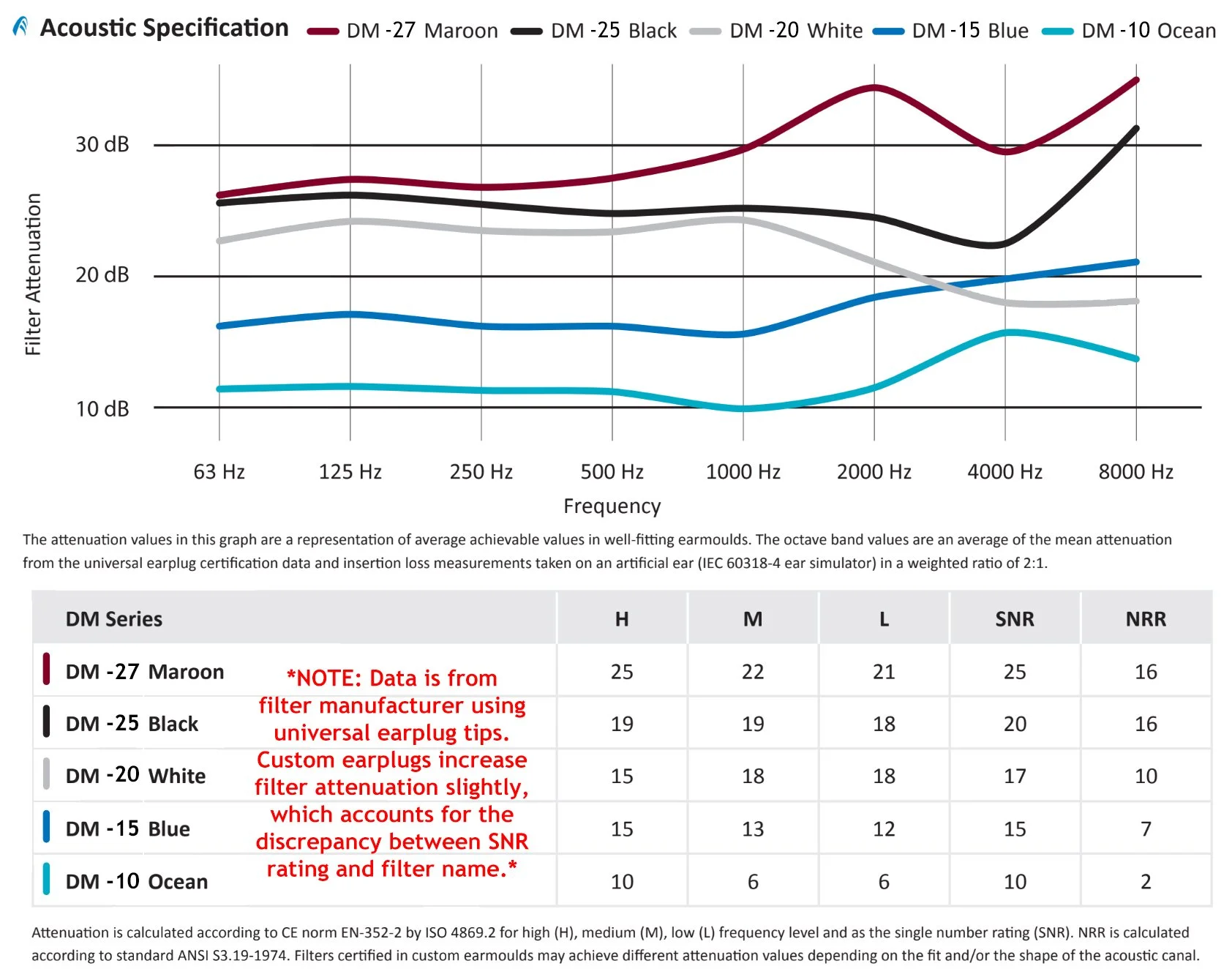
We use Dynamic Ear Company filters. Specifically their DM line, which is their “top line flat attenuating filters, for the sound connoisseur.”
Tell me about all my color options!
Here is the infamous glitter menu. If you get the glitter add-on, you can choose up to four glitters to blend, swirl or color-block together. Here is an example of G5+A5+A11 blended, swirled, and color-blocked (left-to-right) in clear silicone.
Here are all the base silicone color options. Most people choose clear silicone with glitter. You can get colored silicone with glitter, but you have to be a bit more strategic (confetti glitters won’t show up in opaque silicone base colors, for example).
What are sleep plugs and how are they different from solid total block plugs?
Both types of earplugs are solid and filterless. While solid total block plugs are for more industrial use, sleep plugs are made from a softer silicone and are concave on the outside to allow for your ear to rest comfortably on a pillow.
Do you sell gift certificates?
Yes, the Crystal Guardian website store has digital gift certificates available.
I’m not local to the New York-area. Can I still get earplugs from you?
Yes! You can visit an audiologist local to your area to get your ear impressions taken and then ship those to: Studio G c/o Crystal Guardian 44 Dobbin St. Brooklyn, NY 11222.
What specifications should I tell my audiologist if I’m sending in ear impressions?
To make sure your earplugs fit and function correctly, please make sure the ear impressions go COMPLETELY PAST the second bend in the ear canal and the concha and tragus area is fully filled in. If this is not the case, the impressions will be rejected. Feel free to email a photo of both impressions from the side, so the full length and tip are visible to confirm they’re useable.
Jaw position and facial expression change the shape of the ear canal. If you will be making extreme jaw movements or facial expressions while wearing the earplugs, it’s recommended to recreate those same motions during the fitting. For vocalists, singing or lip-syncing during the fitting is recommended. Musicians should recreate embouchure or “stank face.”
Do you keep my ear impressions on file if I ever need to order more in the future?
Yup! All customer ear impressions are safely stored on file for 3 years in a secret vault located 300 feet underground.
I lost my earplugs. How do I re-order?
You can place a re-order on CG’s online store, the same way you placed your original order. Please specify it’s a re-order on the order form. You should get refit if you’re reordering and it’s been more than 3 years since your initial fitting, as ear canals slowly change over time.
I lost only one earplug. Can I re-order one side?
Yes! —> Replacement for 1 earplug side
How long do custom earplugs last?
Custom earplugs should last around 5+ years if taken care of. The earplugs shouldn’t degrade much with normal use over time, but your anatomy may change over the course of 5 years or so, which can potentially limit earplug lifespan. It is not unheard of for customs to last 10 years though. If the seal starts to break, they become uncomfortable or the silicone rips, you should get a new pair. If re-ordering earplugs after 3 years, a new ear impression is recommended.
Where are the earplug instructions?
Here: crystalguardian.xyz/instructions
Has Crystal Guardian been featured in the press?
Yes! We’ve been featured in GQ, New York Magazine’s The Strategist, Resident Advisor, Hypebeast, and ProSoundWeb, among others. You can read coverage on our Press page.
What forms of payment do you accept?
All credit cards and Apple Pay through the online store.
Do you accept HSA/FSA payment?
Yes! But the real question is whether your HSA/FSA accepts us, young padawan.
What is your policy if my package is stolen or lost after delivery?
All packages are shipped with signature confirmation. If tracking info says the package was delivered when you didn’t sign for it, please contact me and your local post office.
Do you ship internationally?
Yes, please select the international shipping option or send an email if you don’t see your country listed.
Does wearing custom earplugs make me immune from hearing damage no matter what?
Like any PPE, wearing custom earplugs does not make you immune from harm. Please wear responsibly and do not wear light filters during an event where you are exposed to extreme volume. Using the free NIOSH Sound Level Meter app (iOS only) is always encouraged!
Are your filters rated NRR or SNR? What does this mean?
NRR and SNR are both statistical deratings from a filter's lab-tested attenuation: NRR subtracts 2 standard deviations from mean attenuation to arrive at a a very conservative estimate, while SNR subtracts 1 standard deviation. This is why SNR numbers read higher than NRR numbers for the same filter. Custom earplugs should have a good, deep seal, so the SNR number is the more appropriate number to reference.
What our filters (Dynamic Ear’s DM line) are rated:
-10dB filters have a SNR of 10 and NRR of 2.
-15dB filters have a SNR of 15 and NRR of 7.
-20dB filters have a SNR of 17 and NRR of 10.
-25dB filters have a SNR of 20 and NRR of 16.
-27dB filters have a SNR of 25 and NRR of 16.
Note: Data is from filter manufacturer using universal earplug tips. Custom earplugs increase filter attenuation slightly, which accounts for the discrepancy between SNR rating and filter name.
Can I use SNR to roughly calculate safe exposure time?
Yes, the “Environmental dbA − Filter SNR = Exposure dBA” formula can be used for flat-attenuating filters to come up with a rough exposure level estimation, which can then be plugged into NIOSH’s sound exposure standard. So a 100dBA club - 17 SNR = roughly 83dBA exposure. This estimate is based on average room exposure. Speaker-huggers beware: sound levels right next to speakers/subs are significantly higher.
Note: This method should not be relied on to produce precise real-world readings, as there are many variables in music sound exposure. A general rule of thumb: if your ears feel fatigued or are ringing after an event, use a stronger filter.
More complicated nerd answer: The standard formula technically subtracts SNR from C-weighted environmental SPL, not A-weighted, but this formula was built for industrial noise and becomes inaccurate at large C−A gaps, like clubs and concerts. The most accurate way to calculate exposure while wearing musician earplugs is the full octave-band method, which breaks down venue SPL and filter attenuation frequency band-by-band. This can roughly match the simpler "SPL dBA − filter SNR = exposure dBA" formula, which is a valid shortcut specifically for filters with flat attenuation across frequency.
What are impulse filters?
Impulse filters utilize the same acoustic membrane as music filters, but there’s an added metal disk that reacts to high-impulse soundwaves. When a gunshot goes off, the pressure of the soundwave pushes on the metal disk and makes a temporary seal and reduces sound. Impulse filters have a NRR of -19dB and a SNR of -13dB when the metal disk isn’t activated. Data below shows results when metal disk is activated. Used mostly with handgun caliber guns outdoors (not indoors, which requires the addition of over-the-ear protection).

Can your “Savory Silence” earplug line be used with filters?
Unfortunately not.
Click here to read CG's Hearing Health one-pager!
〰️
Click here to read CG's Hearing Health one-pager! 〰️
Hearing Health Tools
Compiled by Sound Culture’s Dr. Laura Sinnott AuD
SOUND LEVEL METERS (SLM)
1. The Apple Watch Noise app is the most accurate consumer SLM.
2. After which comes NIOSH’s SLM app (iOS only): Features a built-in noise dosimeter, which measures noise exposure levels over time. Press the play button at the bottom and when your noise dose reaches 100% you are now at risk for permanent hearing loss according to the NIOSH recommended exposure limits (RELs).
3. All Android sound level meter apps must be calibrated with a sound level meter due to the large number of different manufacturers (hardware) that run the Android OS.
APPLE HEARING HEALTH TOOLS
1. Check your listening levels over time: https://support.apple.com/guide/iphone/check-your-headphone-levels-iph0596a9152/ios
2. Airpods Pro Adaptive Transparency Mode - reduces sounds over 85 dB. NOT a replacement for earplugs, but better than nothing.
ANDROID HEARING WELLNESS TOOLS
1. Only available with Pixel Buds Pro: Review volume levels and enable volume level notifications
AUDIOLOGY / HEARING HEALTH for MUSIC INDUSTRY PROFESSIONALS
https://www.tunedcare.com/musicares
Ask your employer to add Tuned hearing health benefits.
TINNITUS RESOURCES
American Tinnitus Association (ATA): https://www.ata.org/
Apps for tinnitus relief: https://www.mindear.com/ https://www.joinoto.com/ https://mindfultinnitusrelief.com/
Device for tinnitus relief: https://neosensory.com/
BROWSER or APP-BASED HEARING SCREENERS
Mimi hearing test app: https://apps.apple.com/us/app/mimi-hearing-test/id932496645 https://play.google.com/store/search?q=mimi%20hearing&c=apps
Jacoti: https://apps.apple.com/us/app/jacoti-hearing-center/id1001095418
WHO hearing screener: https://apps.apple.com/us/app/hearwho-check-your-hearing/id1449966543?ls=1 https://play.google.com/store/apps/details?id=com.hearxgroup.hearwho&pli=1
Shoebox: https://www.shoeboxonline.com/shoebox/?refSource=shoeboxWebsite
Lexie: https://www.wmlexiescreener.com/
Soundly: https://www.soundly.com/hearing-test
SonicCloud: https://hat.soniccloud.com/instruction
Hearing Birdsong: https://www.hearingbirdsong.com/
IN-EAR MONITOR SAFETY
What are your IEM sound levels in your ear canal? https://www.sensaphonics.com/products/db-check-pro
Dangers of pulling one IEM out: Binaural summation, which is the phenomenon that the threshold for hearing the softest sound is higher for two ears than it is for each ear alone.